

Quick Answer
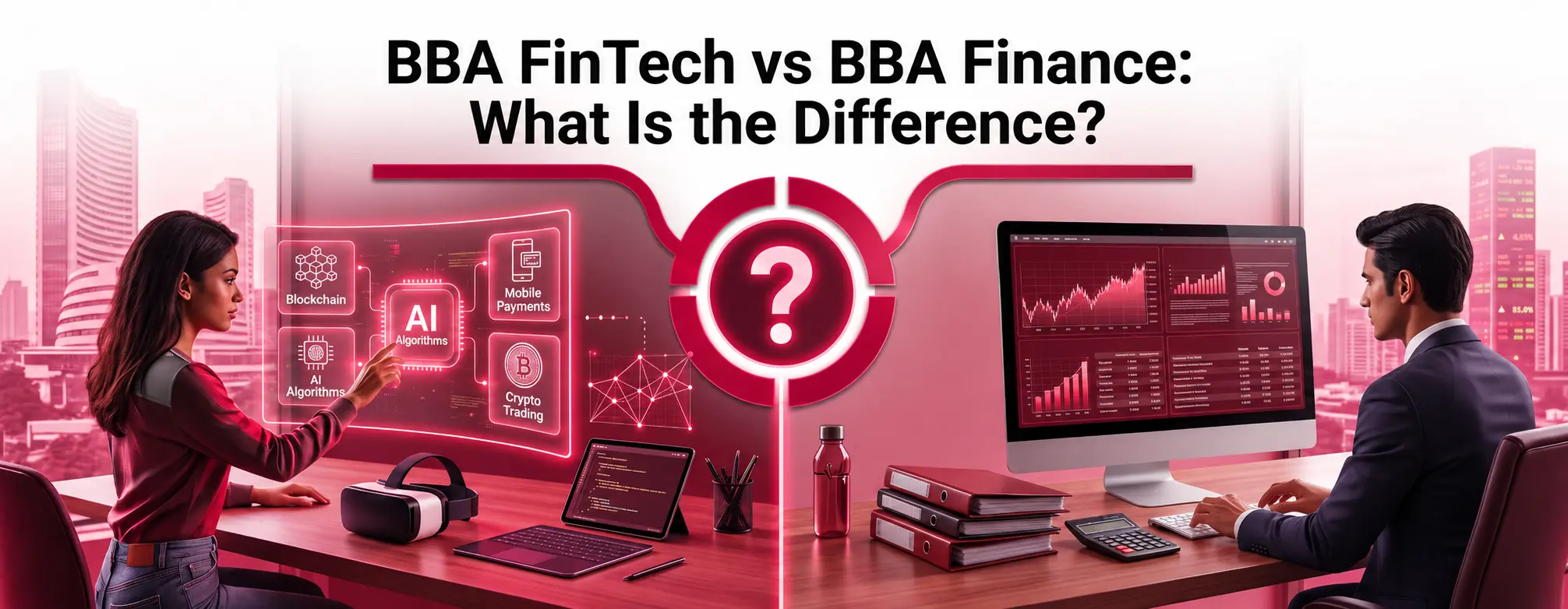
BBA Finance and BBA FinTech sound almost identical, which makes choosing after Class 12 harder than it should be. The BBA FinTech vs BBA Finance difference is mostly one of emphasis. Both teach the same business and finance basics. BBA Finance leans toward financial management, banking and investment. BBA FinTech keeps that base and adds AI, automation, digital finance and data analytics.
Why Is BBA in FinTech Gaining Demand Among Students?
Bachelor of Business Administration in FinTech is gaining demand as the finance industry increasingly adopts AI, automation, data analytics and digital financial systems. Unlike traditional finance-focused programmes, it combines business and finance fundamentals with technology-driven skills.
The course provides practical exposure to AI tools, digital finance, SAP FICO, Advanced Excel, Tableau, Python and data analytics, along with a one-year paid internship to build industry-ready experience.
Table of Contents
BBA FinTech vs BBA Finance: Key Differences
| Factor | BBA Finance | BBA FinTech |
|---|---|---|
| Core focus | Financial decision-making | Finance plus technology |
| Technology | Limited to moderate | High |
| AI exposure | Usually minimal | A defined part of the course |
| Data analytics | Introductory | Applied and tool-based |
| Digital finance | Covered lightly | A central theme |
| Typical tools | Excel, accounting basics | Tally, SAP, analytics, AI tools |
| Career direction | Banking, corporate finance | Tech-enabled finance, analytics |
| Suitable for | Conventional finance interest | Finance plus technology interest |
Different directions, different strengths — the right choice depends on your interests and career goals.
How AI Is Changing Finance
AI is the clearest line between the two degrees. In finance it powers data analysis, reporting, fraud detection, forecasting and compliance. It helps to separate the pieces: AI concepts are the ideas, AI tools are the software, automation handles repetitive tasks, and traditional finance skills are the judgement underneath. AI is not replacing finance professionals; roles now reward people who understand data and technology alongside financial knowledge.
How AI is changing the finance job market:
- Routine, data-heavy tasks such as data entry, reconciliation and basic reporting are increasingly automated, lowering demand for purely clerical finance roles.
- Roles are growing at the finance and technology border, including FinTech Engineers, Financial Data Analysts and AI specialists.
- Employers increasingly expect AI and data skills alongside finance knowledge, not instead of it.
- The shift favours augmentation over replacement: AI handles repetitive work while people interpret results, decide and manage risk.
- The clearest advantage goes to graduates who pair a finance foundation with analytics and AI-tool fluency.
BBA FinTech vs BBA Finance: Which one to choose?
Both BBA Finance and BBA FinTech can lead to rewarding careers, but they prepare you for different areas of the financial industry. BBA Finance focuses on core finance principles, while BBA FinTech combines finance with technology, AI, data analytics and digital financial systems.
Choose BBA Finance if you:
- Want to build a career in traditional finance, banking, accounting or investment.
- Enjoy financial concepts, analysis and decision-making.
- Plan to pursue professional qualifications such as CA, CFA, CMA or an MBA in Finance.
- Prefer a conventional finance-focused curriculum and career path.
Choose BBA FinTech if you:
- Want to understand how technology is transforming the finance industry.
- Enjoy working with data, dashboards, automation and AI tools.
- Want hands-on exposure to tools such as SAP FICO, Advanced Excel, Tableau and Python.
- Prefer combining business and finance knowledge with practical technology skills.
Which One Is Right for You? If your goal is a traditional career in finance, BBA Finance can provide a strong foundation. But if you want to prepare for the technology-driven future of finance, BBA FinTech offers a more integrated approach by combining finance, business and emerging technology skills.
Career Opportunities
The two degrees overlap, but they point towards slightly different job profiles.
| BBA Finance | BBA FinTech |
|---|---|
| Financial Analyst | Financial Data Analyst |
| Banking Associate | FinTech Operations Associate |
| Investment Analyst | Business Intelligence Analyst |
| Accountant / Auditor | SAP Finance (FICO) Consultant |
| Credit and Risk Analyst | Risk and Fraud Analytics Associate |
| Corporate Finance Executive | Digital Payments and Product Associate |
Job titles vary by employer. Treat this as a guide to career direction, not a fixed list.
Both paths can lead to further study. BBA Finance graduates often move towards an MBA in Finance or professional certifications. BBA FinTech graduates can pursue an MBA, or specialise further in data analytics, financial technology or risk management.
Eligibility & Duration
- Eligibility: 10+2 or equivalent from a recognised board, as per the university’s admission guidelines.
- Duration:4 years (8 semesters) under the NEP 2020 undergraduate structure, including a paid internship in semesters 5 and 6.
- ✓ UGC-recognised BBA from ARKA JAIN University
- ✓ 1-year paid internship, semesters 5 and 6
- ✓ 10+ simulation tools, TallyPrime to SAP FICO to Python
5 Simple Steps
Admission Process
01
Enquiry
Connect with the admission team
02
Counselling
Check eligibility, fees and fit
03
Documents
Submit required documents
04
Registration
Confirm your seat with the university
05
Orientation
Begin semester one on campus
Where You Study
A Classroom Program at ARKA JAIN University
This is a full-time campus degree. The specialised fintech, AI and finance papers sit inside the curriculum, delivered through SkillVarsity’s practical learning model by subject matter experts.
Arka Jain University, Jamshedpur
Students in and around Jamshedpur, Chaibasa, Seraikela-Kharsawan, Ghatshila and Purulia can look for this program here.
Ready to turn your BBA into a career advantage?
Learn AI, finance technology and industry tools, gain hands-on experience and complete a 1-year paid internship during your BBA.
Frequently Asked Questions
What is the main difference between BBA FinTech and BBA Finance?
BBA Finance focuses on financial management, banking and investment. BBA FinTech covers the same business and finance basics but adds AI, automation, digital finance and data analytics.
Is BBA FinTech better than BBA Finance?
Not universally. BBA FinTech suits students who want a technology-oriented route into finance. BBA Finance suits those who prefer conventional finance roles or plan to pursue qualifications like CA or CFA.
Do I need coding skills to study BBA FinTech?
No prior coding experience is usually required. Programmes introduce tools such as Python, Excel and Tableau from the basics, though comfort with numbers and logical thinking helps.
Will AI replace finance jobs?
AI is automating routine tasks like data entry and reconciliation, but it is not replacing finance professionals. Roles are shifting towards people who can interpret data, manage risk and make decisions using both finance knowledge and technology.
Can I do an MBA after BBA FinTech?
Yes. A BBA FinTech is a recognized business degree, so you can apply for an MBA in Finance, Business Analytics, Marketing or other fields, subject to each institute’s admission criteria.