


Quick Answer
AI in accounting automates routine work like data entry, reconciliation and basic tax filing, while humans move to analysis, judgement and advisory roles. For students, this means one thing: a degree alone is no longer enough. Job-readiness now needs software skills, AI literacy and real internship experience built into the course, not chased after it.
AI and Accounting, in one line
Ask a commerce student today what scares them about accounting, and the fear has shifted. It used to be “Will I get placed?” Now it is “Will AI leave any accounting job worth getting?”
The fear is fair, but it is only half the story. AI is not ending accounting careers. It is splitting them: people who can work with these tools and people being replaced by them. Which side you land on is decided long before the interview, by what you trained to do.
Table of Contents
1. How AI Is Changing Traditional Accounting Roles
AI is moving the accountant’s job away from recording numbers and toward explaining them. The manual, repetitive layer, data entry, transaction categorisation, reconciliation and basic tax filing are increasingly automated. What stays with humans is judgement, analysis and advice.
In practice, the role is moving up a level. A junior who once spent the whole day keying in vouchers is now expected to review AI-generated entries, catch the errors the software misses, and turn clean data into insight a manager can act on.
The title may still say “accountant”, but the daily work looks closer to an analyst. So students who train only for typing are training for the part that is disappearing.
2. The Data Behind the Shift
The numbers point one way: commerce is rising, but only for students who bring skills alongside the degree.
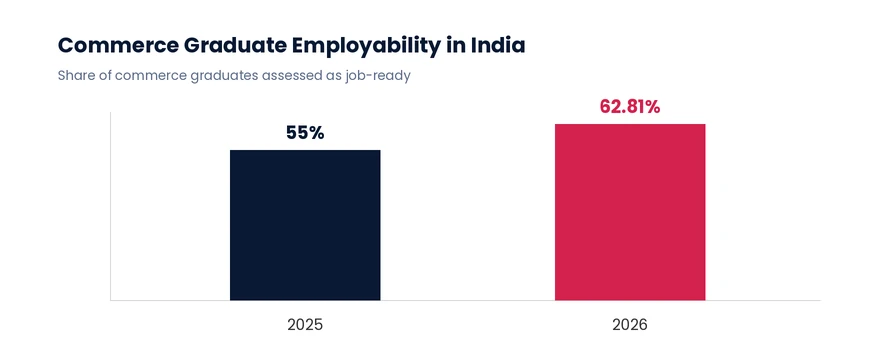
Source: India Skills Report 2026 (published by ETS with CII, AICTE, AIU and Taggd), based on the Global Employability Test across 1 lakh+ candidates. See reported figures →
Commerce graduate employability rose to 62.81% in 2026, up from 55% a year earlier, driven mainly by hiring in BFSI and fintech. That is real progress. Even so, it still leaves close to four in ten commerce graduates assessed as not job-ready.
The same report ranks AI, data analytics and cloud among the most in-demand skills, with over 90% of employees already using generative AI at work. In short, AI is not a distant trend. It is inside the tools you will use in your first job.
AI will not take the accountant’s job. An accountant who uses AI will take the job of one who does not.
3. Will AI Replace Accountants?
Short answer: no, but it is changing what the job looks like. So AI is automating routine work and pushing accountants toward judgement and advisory roles. The tasks disappear. The profession does not.
| Tasks AI now handles | Tasks that still need you |
|---|---|
| Data entry and bookkeeping | Interpreting what the numbers actually mean |
| Bank and ledger reconciliation | Advising on cash flow, cost control and planning |
| Basic GST and tax filing | Handling complex, judgement-based tax matters |
| Standard report generation | Explaining results to management and clients |
| Invoice and document extraction | Spotting fraud, risk and unusual patterns |
Roles built purely on manual data entry, like basic bookkeeping and payroll clerking, face the most pressure. By contrast, roles that pair finance knowledge with analysis are the ones growing. The bookkeeper of the past is becoming the data analyst and advisor of the present.
4. The Real Problem for Freshers
Underneath the AI worry sits an older one: a degree teaches theory, but employers expect experience. As a result, AI only widens that gap.
- You know accounting theory but have rarely touched TallyPrime, SAP FICO or Advanced Excel on real company data.
- Meanwhile, companies ask for experience that freshers are never given the chance to build.
- Software and AI tool knowledge is assumed by recruiters, but not taught in most classrooms.
- Finally, years are spent preparing for a job market that has already moved on.
None of this is your fault. It is a structural gap, and the fix is not more theory. Instead, it is building job-readiness during the degree, not after it.
5. How to Become Job-Ready in the AI Era
The way to stay relevant is simple: start using the tools now, not after graduation. As a result, the student who has already handled AI-driven software walks into the interview ahead of one who has only read about it.
AI Tools Every Accounting Student Should Practise
These are the categories accounting teams already run, and what to practise in each:
- AI-assisted bookkeeping and data capture: TallyPrime automation, Zoho Books and tools like Dext that read invoices and post entries automatically. Practise reviewing and fixing what they generate.
- Automated reconciliation: platforms that match transactions and flag mismatches. The skill is checking the output, not trusting it.
- Reporting and forecasting: Power BI, Tableau and analytics layers like Fathom that turn ledgers into dashboards. Practise reading the story in the numbers.
- AI copilots for drafting: generative AI for summaries, notes and client emails. Learn where it gets things wrong.
So you can begin from day one. Most of these tools have free or student versions. Then load a small set of real numbers and practise the review-and-correct loop until it feels routine. That habit, more than any certificate, is what makes you AI-ready.
Where Practice Turns Into a Job
This is where skill-based learning changes the outcome. SkillVarsity’s programs are built around hands-on practice instead of theory, so students work on real accounting software and AI-aware tools from early in the course, not after three years of reading.
The 1-year paid internship then puts them inside real accounting teams, where they see firsthand how modern businesses use AI and technology day to day. Ultimately, that workplace exposure is the one thing a classroom cannot manufacture, and it is what turns a fresher into a hire.
6. Career Paths After a Skill-Based Finance & Accounting Degree
- Entry level: Accounts Executive, GST Filing Executive, Accounts Payable/Receivable Executive, Junior Financial Analyst
- Mid-level: Financial Analyst, Internal Auditor, Tax Associate, MIS / Data Analyst
- Senior level (with experience): Finance Manager, Audit Manager, FP&A Analyst, SAP FICO Consultant
Still, AI does not remove these roles. Instead, it raises the bar, rewarding people who pair accounting knowledge with technology skills.
7. Eligibility & Duration
Eligibility is a Class 12 pass from any recognised board, commerce preferred, with science and arts applicants also considered, subject to university guidelines. In addition, the program follows the four-year, eight-semester structure under NEP 2020, including the internship period.
5 Simple Steps
Admission Process
01
Enquiry
Reach out to the admissions desk
02
Counselling
Eligibility, fees & university fit
03
Documents
Submit certificates & marksheets
04
Registration
Confirm your seat with the university
05
Orientation
Begin semester one on campus
Study Near Home
Classroom Mode at Srinath University, Jamshedpur
The BBA in Finance & Accounting runs in classroom mode at Srinath University’s Adityapur campus. Students within roughly 100 km can attend on campus and still get the full software, AI and internship-driven training.
Srinath University, Jamshedpur
Students in and around Jamshedpur, Adityapur, Seraikela-Kharsawan, Chaibasa, Ghatshila and Purulia can look for this program here, close to the Adityapur industrial and IT corridor.
Don’t fear AI. Learn to work with it.
A finance degree that builds software skills, AI literacy and real internship experience from semester one, so you graduate ready for the job AI is reshaping, not afraid of it.
- ✓ 1-year paid internship for real industry exposure
- ✓ 90% practical learning, software and AI-aware tools
- ✓ Classroom mode with placement support (subject to eligibility)
Frequently Asked Questions
What is AI in accounting?
AI in accounting is the use of software to automate repetitive financial tasks such as data entry, categorisation, reconciliation and basic tax filing, so accountants can focus on analysis, judgement and advisory work.
Will AI replace accountants in India?
No. AI is automating routine, rule-based tasks, not the profession. Demand is shifting toward accountants who can interpret data, advise on decisions and use AI tools well. Purely manual data-entry roles are the ones under pressure.
Which AI and software skills do accountants need now?
The core stack is TallyPrime, SAP FICO, Zoho Books and Advanced Excel, plus Power BI or Tableau for reporting. On top of that, AI literacy matters: using AI-assisted reconciliation and extraction tools and knowing their limits.
Do I still need to learn Tally and SAP if AI automates accounting?
Yes. AI runs on top of these systems; it does not remove them. Employers still expect you to operate TallyPrime and SAP FICO and to supervise the automated output for errors and exceptions.
Is a BBA in Finance and Accounting a good choice in the AI era?
It is a strong choice when it is skill-based. A degree that combines finance knowledge with software training, AI-aware tools and a paid internship builds exactly the finance-plus-technology profile employers are hiring for.
How does a paid internship help me become job-ready?
An internship converts theory into documented experience. You work on real accounts and software, which is exactly what recruiters mean when they ask freshers for experience. A stipend is payable as per the applicable agreement; confirm terms with the institution.
Can students near Jamshedpur study this in classroom mode?
Yes. The BBA in Finance & Accounting runs in classroom mode at Srinath University’s Adityapur campus in Jamshedpur. Students within roughly 100 km, including Seraikela-Kharsawan, Chaibasa, Ghatshila and Purulia, can attend on campus.